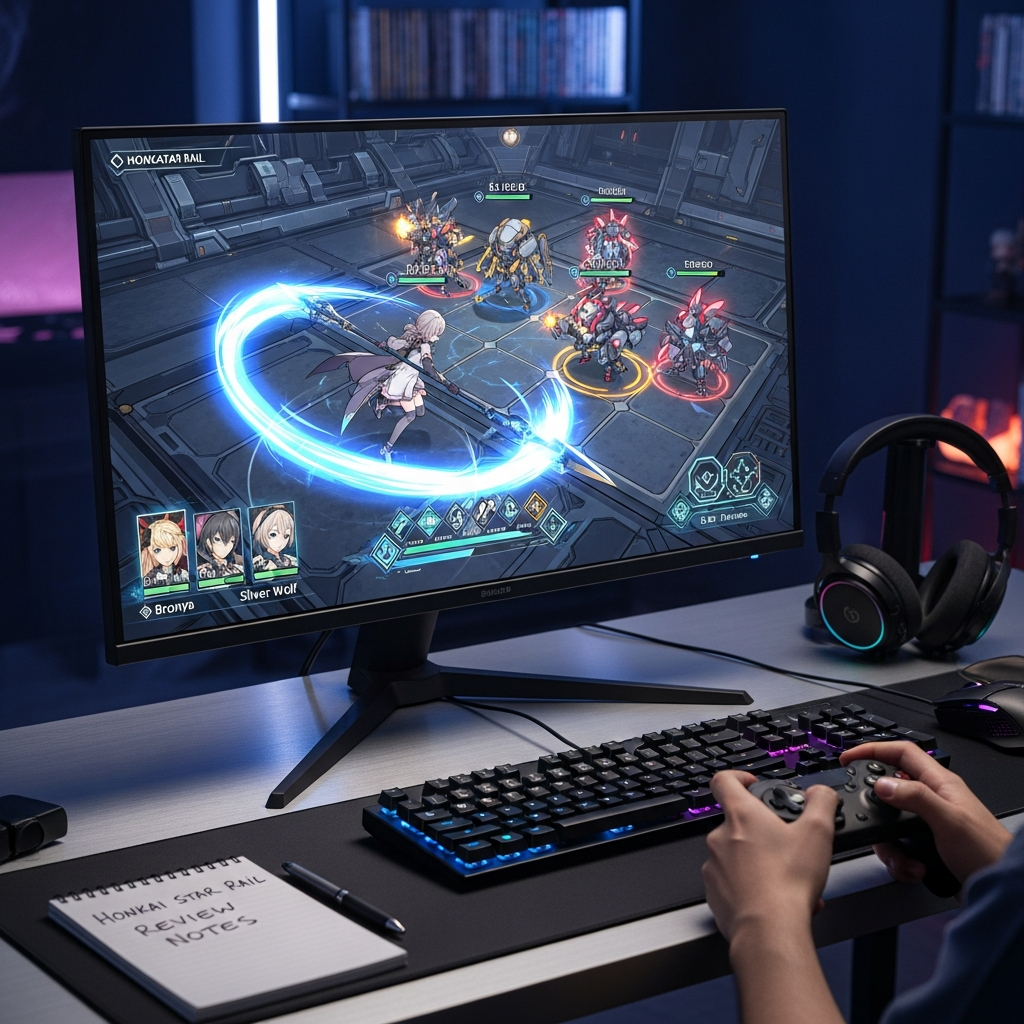
Honkai: Star Rail is a captivating turn-based role-playing game developed by HoYoverse, known for its rich storytelling, stunning visuals, and strategic combat. This spacefaring adventure invites players to board the Astral Express and journey across various planets, unraveling mysteries and engaging in thrilling battles. The game successfully blends elements of classic JRPGs with modern gacha mechanics, offering a compelling experience for both seasoned players and newcomers to the genre. Honkai Star Rail’s enduring popularity, with millions of daily and monthly active users, speaks volumes about its engaging Honkai Star Rail gameplay & review.

Embarking on the Astral Express: A Journey Through Story and World
The core of Honkai: Star Rail lies in its expansive narrative, which sees players take on the role of the Trailblazer, an amnesiac protagonist with a Stellaron embedded within their body. This intriguing mystery drives the main story, known as Trailblaze Missions, which guide players through diverse worlds and introduce a colorful cast of characters, each with their own unique backgrounds and motivations. The developers at HoYoverse have a strong reputation for crafting gacha games with a significant emphasis on story, and Honkai: Star Rail is no exception, consistently delivering an enthralling experience.
The game’s world-building is particularly commendable, painting vivid pictures of each planet the Astral Express visits. For instance, the Penacony arc, introduced in Version 2.0 and concluding with Version 2.2, is often highlighted as one of the game’s best storylines. This arc immersed players in a “Planet of Festivities,” embroiled in a dark struggle for freedom, offering twists, turns, and a rollercoaster of emotions. Even seemingly minor NPCs are brought to life with expressive voice acting, enhancing player investment in the narrative. The compelling storyline, combined with cinematic cutscenes and well-developed characters, forms a significant part of the positive Honkai Star Rail gameplay & review.
Beyond the main campaign, Honkai: Star Rail provides numerous side quests and companion missions that delve deeper into the lore and character backstories. These optional activities not only offer valuable resources like Stellar Jade (the game’s premium currency) and character experience materials but also enrich the player’s understanding of the universe. The developers regularly introduce new content, including major story updates and limited-time events, which keep the narrative fresh and continuously expand the game’s universe. This consistent stream of new content ensures that the Honkai Star Rail gameplay & review remains dynamic and engaging for its dedicated player base.
Mastering the Cosmos: An In-Depth Look at Combat
At the heart of Honkai: Star Rail’s appeal is its turn-based combat system, which offers a refreshing blend of strategy and accessibility. Unlike fast-paced action games, battles in Honkai: Star Rail require careful planning and tactical decision-making, reminiscent of classic Japanese RPGs like Final Fantasy and Dragon Quest. This strategic depth is a crucial aspect of the positive Honkai Star Rail gameplay & review, setting it apart in the crowded mobile gaming landscape.
Core Combat Mechanics
Understanding the fundamental combat mechanics is vital for success in Honkai: Star Rail. Here are the key elements:
- Turn-Based Actions: Characters and enemies take turns based on their Speed stat, influencing the Action Order.
- Skill Points: This is a crucial resource managed across your four-character party.
- Basic Attacks: These regenerate one Skill Point, allowing for sustained combat.
- Skills: Stronger abilities that consume one Skill Point, often dealing more damage or providing significant buffs/debuffs.
- Ultimates: Powerful attacks that can be activated at any time once a character’s Energy meter is full, even outside their turn.
- Elemental Weaknesses and Toughness: Every enemy possesses elemental weaknesses. Attacking an enemy with a matching elemental type depletes their Toughness bar, functioning somewhat like a secondary health bar.
- Weakness Break: When an enemy’s Toughness bar is fully depleted, they suffer a “Weakness Break.” This causes them to take increased damage, delays their next action, and applies a specific elemental debuff or damage-over-time (DoT) effect. For example, a Quantum Weakness Break applies Entanglement, delaying action and dealing Quantum DoT, while a Fire Weakness Break applies a Burn effect.
- Paths: Each character adheres to a specific “Path” (e.g., Destruction for damage, Abundance for healing, Preservation for shielding, Harmony for buffs, Nihility for debuffs). These Paths define their combat role and the type of Light Cones (equipment) they can use. This path system enhances the strategic depth of the Honkai Star Rail gameplay & review, as players must consider character roles when building teams.
- Technique Attacks: Before initiating combat, players can use Technique Points to unleash a character-specific “Technique.” These can deal initial damage, apply debuffs to enemies, or grant buffs to allies, giving an advantage at the start of battle.
The intricate interplay of these mechanics makes each battle a tactical puzzle. While the game provides an auto-battle system, especially useful for farming, more challenging content often demands manual control and strategic foresight. This balance between convenience and depth is a key highlight in many Honkai Star Rail gameplay & review discussions.
Team Building and Character Synergy
Building an effective team is paramount in Honkai: Star Rail. Players typically aim for a balanced composition, often including at least one strong damage dealer, a sustain character (healer or shielder), and support characters to buff allies or debuff enemies. The game encourages experimentation with different character combinations to exploit elemental weaknesses and create powerful synergies.
The diverse roster of characters, each with unique abilities and “Traces” (passive skills), allows for a vast array of team compositions. For example, some characters are excellent at dealing damage, while others specialize in healing or providing crucial support. Recent updates, such as Version 2.0 and beyond, have introduced new mechanics like the “Super Break” and characters that challenge traditional energy bar systems, further diversifying team-building strategies and keeping the Honkai Star Rail gameplay & review fresh. The ongoing evolution of combat mechanics and character releases consistently adds new layers to the Honkai Star Rail gameplay & review experience.
Progression and Customization: Beyond the Battle
Honkai: Star Rail offers a robust progression system that keeps players engaged as they journey across the stars. This involves several interlocking elements that allow for deep customization and power growth, directly influencing the overall Honkai Star Rail gameplay & review.

Character Development
- Leveling and Ascension: Characters gain experience through EXP materials, increasing their stats and unlocking new abilities. Reaching certain level milestones requires “Ascension,” which consumes specific materials obtained through farming activities.
- Traces: These are passive abilities and stat bonuses that can be upgraded using specific materials, further enhancing a character’s combat prowess. Prioritizing trace upgrades for favorite characters is crucial for efficiency.
- Eidolons: Similar to constellations in other HoYoverse games, Eidolons are unlocked by obtaining duplicate characters, granting significant power boosts to their skills.
Equipment Systems
- Light Cones: These act as a character’s weapon, providing stat boosts and unique passive skills. Matching a Light Cone’s Path type to the character’s Path is essential for optimal performance. The game offers various ways to obtain Light Cones, including through the gacha system and event rewards.
- Relics: These are akin to armor pieces, offering significant stat boosts like Crit Rate, HP, and Attack. Relics come in sets, providing additional bonuses when equipped in specific combinations (e.g., 2-piece or 4-piece sets). While some players advise waiting until higher Trailblaze Levels to farm relics, it’s generally beneficial to gradually upgrade them to ease progression. Recent quality-of-life updates have even made subsidiary statistics for non-upgraded Relics visible by default, aiding in better decision-making.
The constant cycle of acquiring materials, leveling characters, and optimizing equipment ensures a satisfying sense of progression. However, resource management is key, especially for free-to-play players, as materials can be limited. The auto-battle feature helps alleviate some of the grinding for these materials, allowing players to focus on other aspects of the game. This thoughtful design contributes positively to the Honkai Star Rail gameplay & review.
The Gacha System: Navigating the Warps
As a free-to-play game, Honkai: Star Rail incorporates a “gacha” system, known as “Warping,” for obtaining new characters and Light Cones. This monetization model is a common feature in many mobile RPGs and is an integral part of the Honkai Star Rail gameplay & review.
Understanding Warps
- Stellar Jade: This is the primary in-game currency used for Warping. Players can earn Stellar Jade through completing missions, events, daily training, and exploration.
- Banner Types:
- Standard Warp (Stellar Warp): A permanent banner featuring a wide range of characters and Light Cones.
- Character Event Warp: Limited-time banners that feature specific powerful new 5-star characters, often accompanied by boosted rates for certain 4-star characters.
- Light Cone Event Warp: Limited-time banners specifically for powerful 5-star Light Cones that synergize with featured characters.
- Pity System: Honkai: Star Rail utilizes a “pity system” to guarantee a 5-star character or Light Cone after a certain number of pulls, mitigating the randomness of the gacha. This system makes the gacha experience more predictable and player-friendly compared to some other games.
- Departure Warp: A special discounted banner for new players that guarantees a 5-star character within 50 pulls.
While the gacha system can be “treacherous” due to its inherent randomness, many players find Honkai: Star Rail to be relatively free-to-play friendly. The game is generous with in-game currency, and it’s possible to complete all main story and endgame content with free characters, provided players manage their resources wisely. However, the constant release of appealing new characters can make it challenging for players to save enough Stellar Jade to pull for every desired unit, a common discussion point in the Honkai Star Rail gameplay & review.
Endgame Content and Longevity
Beyond the main story, Honkai: Star Rail offers a variety of engaging endgame activities that provide continuous challenges and rewards, ensuring long-term player engagement. These activities are essential for a comprehensive Honkai Star Rail gameplay & review.
Key Endgame Modes
- Forgotten Hall / Memory of Chaos: This is a challenging combat mode where players face increasingly difficult waves of enemies with rotating modifiers. Clearing these stages rewards valuable resources, including Stellar Jade. The Memory of Chaos is particularly difficult, requiring optimized team compositions and strategic thinking.
- Pure Fiction: Another endgame combat mode, Pure Fiction emphasizes dealing continuous damage to multiple enemies within a turn limit, focusing on different team-building strategies compared to Memory of Chaos.
- Simulated Universe: This roguelike mode allows players to explore randomized dungeons, battling enemies and acquiring powerful blessings and curios to enhance their teams. It’s a great way to test new characters and strategies, offering a fresh experience with each run. Recent updates, like Version 4.0, have introduced “Insight Mode” in the Divergent Universe, offering double Synchronicity Points and buffs to ease stage clearing.
- Events: HoYoverse regularly hosts limited-time events, often featuring unique storylines, mini-games, and generous rewards. Many major past events are made permanently available through features like “Conventional Memoir,” allowing new or returning players to experience missed content and earn some rewards, greatly reducing “fear of missing out” (FOMO).
Honkai: Star Rail has shown remarkable staying power since its launch in April 2023. Player counts remain high, with estimates of around 5 million daily active players and 18-20 million monthly active users in 2026, demonstrating its enduring appeal. Regular content drops, strong storytelling, high-quality character design, and consistent events are key factors keeping players invested years after launch. The developers have also been praised for their responsiveness to player feedback, implementing quality-of-life improvements and continuously iterating on endgame content. The commitment to evolving the game ensures a positive long-term Honkai Star Rail gameplay & review.
The Verdict: A Stellar Honkai Star Rail Gameplay & Review
Honkai: Star Rail offers a highly polished and deeply engaging experience that successfully marries the strategic depth of turn-based RPGs with the allure of a character-collecting game. Its compelling narrative, brought to life by a memorable cast and stellar voice acting, provides a strong foundation for the adventure. The tactical combat system, with its emphasis on elemental weaknesses, skill point management, and character synergies, remains consistently rewarding and challenging. This robust Honkai Star Rail gameplay & review highlights its strengths.
While the gacha mechanics are inherent to its free-to-play model, the game’s generosity with in-game currency and the thoughtful design of its progression systems make it accessible and enjoyable even for those who choose not to spend money. HoYoverse’s commitment to regular content updates, quality-of-life improvements, and an expanding universe ensures that the Honkai Star Rail gameplay & review continues to evolve, offering fresh experiences for its millions of dedicated players. Whether you’re a fan of strategic combat, rich storytelling, or simply looking for a new adventure, Honkai: Star Rail stands as a brilliant RPG that promises many more years of enjoyment.
FAQ
Is Honkai: Star Rail free to play?
Yes, Honkai: Star Rail is a free-to-play game. While it features optional in-game purchases through a gacha system (Warping) for new characters and Light Cones, players can experience the entire main story and participate in endgame content without spending money. The game is generous with its premium currency, Stellar Jade, which can be earned through various in-game activities.
What kind of gameplay does Honkai: Star Rail offer?
Honkai: Star Rail features turn-based combat, where players assemble a team of four characters to battle enemies. The gameplay emphasizes strategic decision-making, requiring players to manage skill points, exploit elemental weaknesses to trigger “Weakness Breaks,” and build synergistic teams based on character “Paths” (roles like damage, healing, or support). Beyond combat, it offers extensive story exploration, puzzles, and various endgame challenges.
How often does Honkai: Star Rail receive updates?
Honkai: Star Rail receives regular content updates, typically every few weeks or months, introducing new story missions, playable characters, limited-time events, and game modes. For instance, 2024 saw versions 1.6 to 2.7, with 20 new characters, a new world (Penacony), and new game modes. These consistent updates ensure a dynamic Honkai Star Rail gameplay & review experience and keep the player base engaged.
Is Honkai: Star Rail suitable for new players in 2026?
Yes, Honkai: Star Rail is still highly recommended for new players in 2026. The game has a very active player base, and HoYoverse continues to release significant content updates. Key features like the “Conventional Memoir” allow new players to experience past major events, and the game’s generous nature with in-game resources makes it easy to catch up and build a strong team. The intuitive turn-based system also has a low entry barrier, making it easy to understand and enjoy.
What are “Light Cones” and “Relics” in Honkai: Star Rail?
Light Cones are character equipment that function like weapons, providing stat bonuses and unique passive abilities. Each Light Cone is tied to a specific “Path” and should ideally match the equipped character’s Path for maximum benefit. Relics are gear pieces that boost various stats like HP, Attack, and Crit Rate. They come in sets that grant additional bonuses when specific numbers of pieces are equipped, allowing for deep character customization. Both are crucial for optimizing character performance in Honkai Star Rail gameplay & review.
What is the “pity system” in Honkai: Star Rail’s gacha?
The “pity system” in Honkai: Star Rail’s gacha (Warping) guarantees that players will receive a 5-star character or Light Cone after a certain number of pulls if they haven’t obtained one before. This mechanism ensures that players are eventually rewarded for their investment in Warps, making the gacha experience more predictable and less frustrating.