Marvel Future Fight Review: A Comprehensive Gameplay and Strategy Guide for Beginners
The Marvel Cinematic Universe and its comic book counterparts have dominated global entertainment for over a decade. Among the numerous mobile adaptations, one title stands tall as a veteran in the genre: Marvel Future Fight (MFF). Developed by Netmarble, this high-octane Action RPG has evolved significantly since its launch in 2015.
If you are a fan of the Avengers, X-Men, or the Guardians of the Galaxy, you might be wondering if this game is worth your time and investment in the current year. This article provides a deep-dive Marvel Future Fight gameplay review, exploring its mechanics, progression systems, and whether it remains a top-tier choice for Marvel enthusiasts.
What is Marvel Future Fight?
Marvel Future Fight is a 3D action-oriented role-playing game that allows you to assemble a team of three heroes or villains from a roster of over 250 characters. The narrative begins with a collapse of dimensions, prompting Director Nick Fury to send a message from the future to save the multiverse.
As a player, you take on the role of a commander, managing resources, upgrading your roster, and engaging in various PvE (Player vs. Environment) and PvP (Player vs. Player) game modes. The game is celebrated for its high-quality graphics, frequent updates synchronized with Marvel movie releases, and deep strategic customization.
Core Gameplay Mechanics: The Action RPG Experience
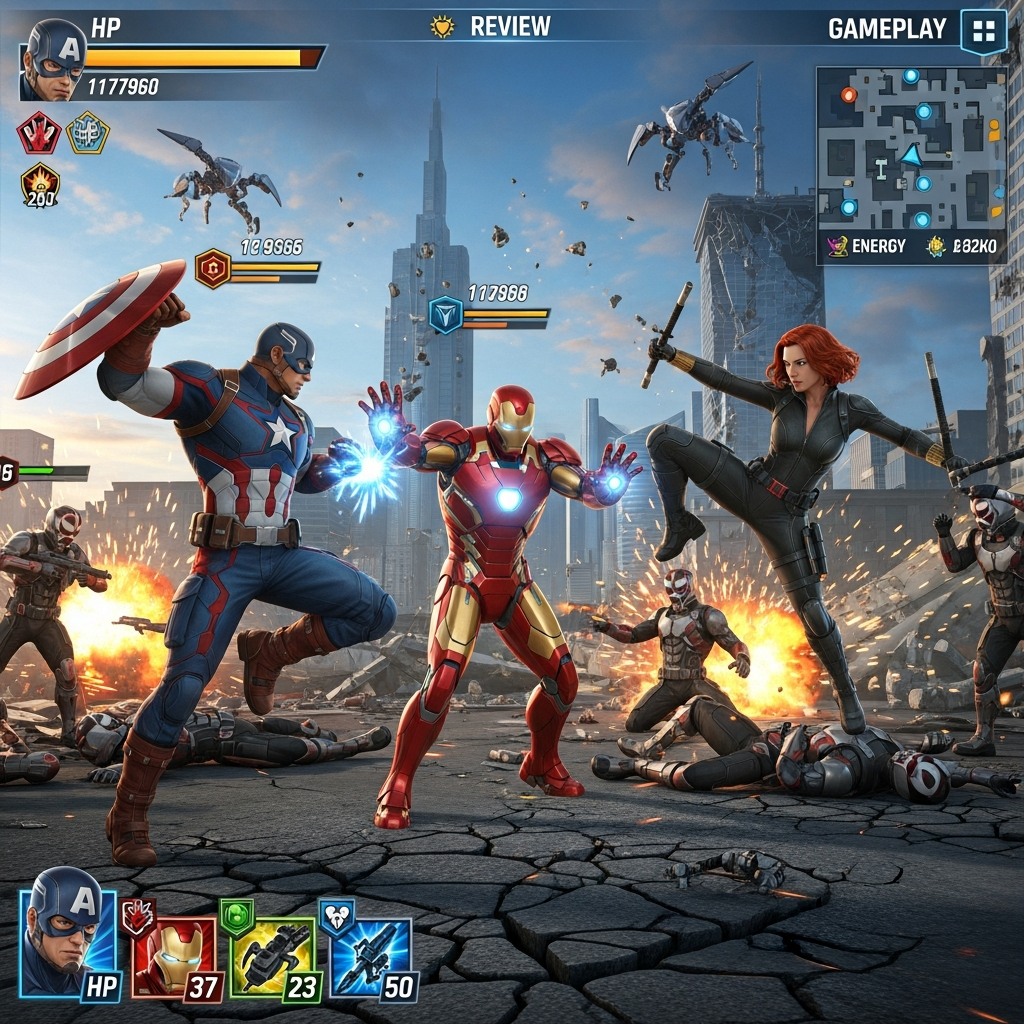
The heart of the Marvel Future Fight gameplay lies in its fluid combat system. Unlike turn-based RPGs, MFF offers a real-time experience where positioning and skill timing are crucial.
1. The Combat System
You control one character at a time while the other two members of your team remain on standby. You can switch between characters mid-battle to exploit elemental advantages or to save a hero with low health.
Each character possesses:
- Basic Attacks: Standard strikes used while skills are on cooldown.
- Active Skills: Five distinct abilities (numbered 1 through 5) that have specific animations and effects.
- Ultimate/Awakened Skills: High-damage abilities available for Tier-3 and Transcended characters.
- Passive Skills: Automatic buffs that trigger under specific conditions.
2. Character Classes and Type Advantages
To succeed in MFF, you must understand the “Rock-Paper-Scissors” mechanic of character classes:
- Combat (Red): Strong against Speed, weak against Blast.
- Blast (Blue): Strong against Combat, weak against Speed.
- Speed (Green): Strong against Blast, weak against Combat.
- Universal (Purple): Neutral against all types but receives a slight bonus against the other three.
Strategically picking your team based on these types is essential for clearing high-level content like World Boss Legend.
The Progression System: Building Your Roster
One of the most complex aspects of Marvel Future Fight is its character progression. It is not enough to simply unlock a character; you must invest heavily to make them viable for endgame content.
Biometrics and Ranking Up
To unlock and rank up characters, you need Biometrics (character shards). Collecting these allows you to increase a hero’s star rating from 1 to 6. Once at 6 stars, you can use Norn Stones to increase their Mastery, which enhances their leadership skill.
Tier Progression: T2, T3, and T4
The game uses a “Tier” system to define power levels:
- Tier-1: The base level for most characters.
- Tier-2: A significant power spike. Most modern content requires a full T2 team at minimum.
- Tier-3 / Transcend Potential: These characters gain an “Ultimate” skill and a massive stat boost.
- Tier-4: The current endgame peak. Tier-4 characters require massive amounts of “Life Seeds” and “Soul of the Faltine,” but they offer unparalleled power for the hardest game modes.
Deep Customization: How to Power Up Your Heroes
A significant portion of your time in Marvel Future Fight will be spent in menus, optimizing your characters. This is where the game transitions from a simple brawler to a complex management simulator.
The Uniform System
Uniforms are perhaps the most critical feature in MFF. A new Uniform doesn’t just change a character’s appearance; it often completely reworks their skill set, changing them from “trash tier” to “meta-defining.” For example, a character like Iron Man might be weak in his base form but becomes a powerhouse with his latest movie-inspired suit.
Comic Cards: The Account-Wide Buff
If there is one thing that separates a veteran from a beginner, it is the Comic Card system. You can equip five cards that provide stat boosts (like Attack, Cooldown Reduction, and Ignore Defense) to every character on your account. Focusing on your card set is the single most important long-term goal in the game.
ISO-8 and Custom Gear (Obelisks & CTPs)
- ISO-8: These are gems you slot into your characters. Equipping sets (like “Overdrive” or “Power of Angry Hulk”) provides significant offensive bonuses.
- Custom Gear: Also known as Obelisks, these provide specific buffs like “Increase Damage by X%” or “Invincibility.” High-end players aim for CTPs (Celestial Tech Prototypes), which are rare items that offer massive competitive advantages.
Exploring the Game Modes
Marvel Future Fight offers a staggering variety of modes to keep players engaged.
1. Epic Quests
These are long-term story campaigns centered around specific groups like the X-Men, Fantastic Four, or the Eternals. Completing these quests rewards you with powerful characters like Magneto, Doctor Strange, or Sentry.
2. World Boss (Ultimate & Legend)
This is the primary PvE mode where you fight iconic villains like Thanos, Galactus, or Knull. Winning these battles is the only way to earn the materials needed for Tier-3 and Tier-4 upgrades.
3. Shadowland
Shadowland is a weekly challenge where you must climb floors of increasing difficulty. It tests the breadth of your roster, as characters used on one floor cannot be used again until the weekly reset.
4. Multiverse Invasion & Giant Boss Raid
These are co-op modes where you team up with other players in real-time. Giant Boss Raid (GBR), specifically the Dormammu stage, is currently the most challenging content in the game and is the primary source of Tier-4 materials.
5. Timeline Battle (PvP)
In this mode, you pit your best three characters against another player’s team controlled by AI. While the rewards (Crystals) are great, the meta is often dominated by a few specific “broken” characters, which can be frustrating for new players.
The Economy: Free-to-Play (F2P) vs. Pay-to-Win (P2W)
A common question in any Marvel Future Fight review is whether the game is F2P-friendly.
The answer is nuanced. Crystals are the premium currency. While you can earn them through daily challenges and leveling up characters, the rate is slow compared to the cost of new uniforms (usually 1,050 to 1,500 Crystals).
However, Netmarble is quite generous with “Check-in Rewards.” New players often receive Mega Tier-2 tickets and Premium Character Selectors for free. While whales (high spenders) will always dominate the top of the PvP rankings, a patient F2P player can clear almost all PvE content over time.
Pros and Cons of Marvel Future Fight
Pros:
- Incredible Graphics: The character models and skill animations are among the best on mobile.
- Massive Roster: Almost every Marvel character you can think of is playable.
- Consistent Updates: The game is updated monthly with new content and characters.
- Deep Strategy: The level of customization allows for significant theory-crafting.
Cons:
- Inventory Management: Dealing with hundreds of items can feel like a chore.
- Power Creep: Older uniforms and characters become obsolete quickly as new ones are released.
- Complexity Overload: The sheer number of systems (Cards, Swords, Artifacts, ISO-8) can be overwhelming for beginners.
Expert Tips for Beginners
If you are starting your journey today, keep these tips in mind to avoid wasting precious resources:
- Focus on Comic Cards First: Do not ignore your cards. Aim for at least 30% “Skill Cooldown” and “Ignore Defense” from your card stats.
- Save Crystals for Sales: Never buy uniforms at full price. There is an all-uniform sale approximately once a month where they are discounted by 40-50%.
- Build Support Characters: Don’t just build damage dealers. Characters like Shuri, Phil Coulson, and White Fox provide massive “Damage to Villains” buffs that are essential for World Boss.
- Join an Active Alliance: Being in an alliance provides stat bonuses and access to Alliance Battle rewards.
The Verdict: Is Marvel Future Fight Worth Playing?
In conclusion, our Marvel Future Fight gameplay review finds that the game remains the gold standard for Marvel mobile RPGs. While its age shows in some cluttered UI elements and the “grindy” nature of endgame progression, the core combat and character loyalty are unmatched.
You should play Marvel Future Fight if you enjoy long-term progression, deep customization, and seeing your favorite Marvel heroes rendered in stunning detail. If you prefer a game that doesn’t require daily commitment, the “daily chore” aspect of MFF might be a deterrent. However, for the dedicated fan, it offers a multiverse of content that few other games can rival.
Frequently Asked Questions (FAQ)
Q: Is Marvel Future Fight offline?
A: No, Marvel Future Fight requires a constant internet connection to play and sync your progress with the servers.
Q: Who is the best character for beginners?
A: Characters like Sharon Rogers (an original MFF character) and Spider-Man (with his latest uniform) are excellent choices for new players due to their high damage and survivability.
Q: How do I get more Crystals?
A: You can earn Crystals by completing daily challenges, reaching higher leagues in Timeline Battle, and leveling up your characters to levels 50, 60, and 70.
Q: What is the “Meta” in MFF?
A: The “Meta” refers to the strongest characters and strategies currently in the game. It changes frequently with new updates and Tier-4 releases.
Q: Can I play MFF on PC?
A: While there is no native PC version, you can play it using official emulators or the Google Play Games beta for PC.