Diablo Immortal Gameplay & Review
Diablo Immortal Gameplay & Review: A Comprehensive Guide to Sanctuary on Mobile
The release of Diablo Immortal marked a significant milestone in the history of Blizzard Entertainment’s legendary action RPG franchise. As the first entry specifically designed for mobile devices—later expanded to PC—it brought the dark, gothic world of Sanctuary to the palms of your hands. If you are a newcomer to the series or a veteran curious about this transition, this guide provides an in-depth Diablo Immortal gameplay and review to help you navigate the depths of Hell.
In this pillar article, we will explore the core mechanics, character progression, social systems, and the controversial monetization aspects that define the experience. By the end of this read, you will have a clear understanding of whether this title deserves a spot on your device.
What is Diablo Immortal? An Overview
Diablo Immortal is a Massively Multiplayer Online Action RPG (MMOARPG) set between the events of Diablo II: Lord of Destruction and Diablo III. You find yourself in a world recovering from the destruction of the Worldstone, yet fragments of this ancient artifact still hold immense power, attracting the forces of the Burning Hell.
Unlike previous titles, Diablo Immortal emphasizes a “living world” where you frequently encounter other players in shared hubs and open-world zones. It maintains the classic hack-and-slash combat the series is famous for while introducing modern mobile gaming conventions.
Choosing Your Hero: The Character Classes
Your journey begins with selecting a class. Each class offers a distinct playstyle, and your choice will significantly impact your Diablo Immortal gameplay experience. As of the latest updates, you can choose from the following archetypes:
1. The Barbarian
The Barbarian is a quintessential melee fighter. If you enjoy jumping into the thick of battle and using brute force to overwhelm enemies, this is the class for you. With skills like Whirlwind and Hammer of the Ancients, you offer high area-of-effect (AoE) damage and excellent survivability.
2. The Crusader
A tanky, faith-driven warrior who excels at crowd control and party buffs. The Crusader rides into battle on a celestial horse (Draw and Quarter), gathering enemies for easy elimination. You are highly valued in group play for your defensive capabilities.
3. The Demon Hunter
The ultimate glass cannon. You use dual crossbows and gadgets to rain destruction from a distance. While you have lower health, your mobility and high single-target DPS (Damage Per Second) make you a formidable force against bosses.
4. The Monk
A fast-paced martial artist who utilizes combos and elemental spirits. The Monk is highly mobile and provides excellent utility to teammates through shields and grouping skills. It requires more finesse and “button-mashing” precision than other classes.
5. The Necromancer
Command the dead to do your bidding. As a Necromancer, you summon skeletons and mages to distract enemies while you explode corpses from the sidelines. This is often considered the most beginner-friendly class for solo play.
6. The Wizard
A master of arcane, fire, ice, and lightning. The Wizard focuses on comboing spells together—such as freezing enemies before shattering them with a meteor. It offers high tactical depth but requires careful positioning.
7. The Blood Knight
The newest addition to the roster, the Blood Knight is a mid-range hybrid that uses polearms and vampiric powers. You consume the life force of your enemies to sustain yourself, offering a dark and unique aesthetic.
Core Gameplay Mechanics: Combat and Controls
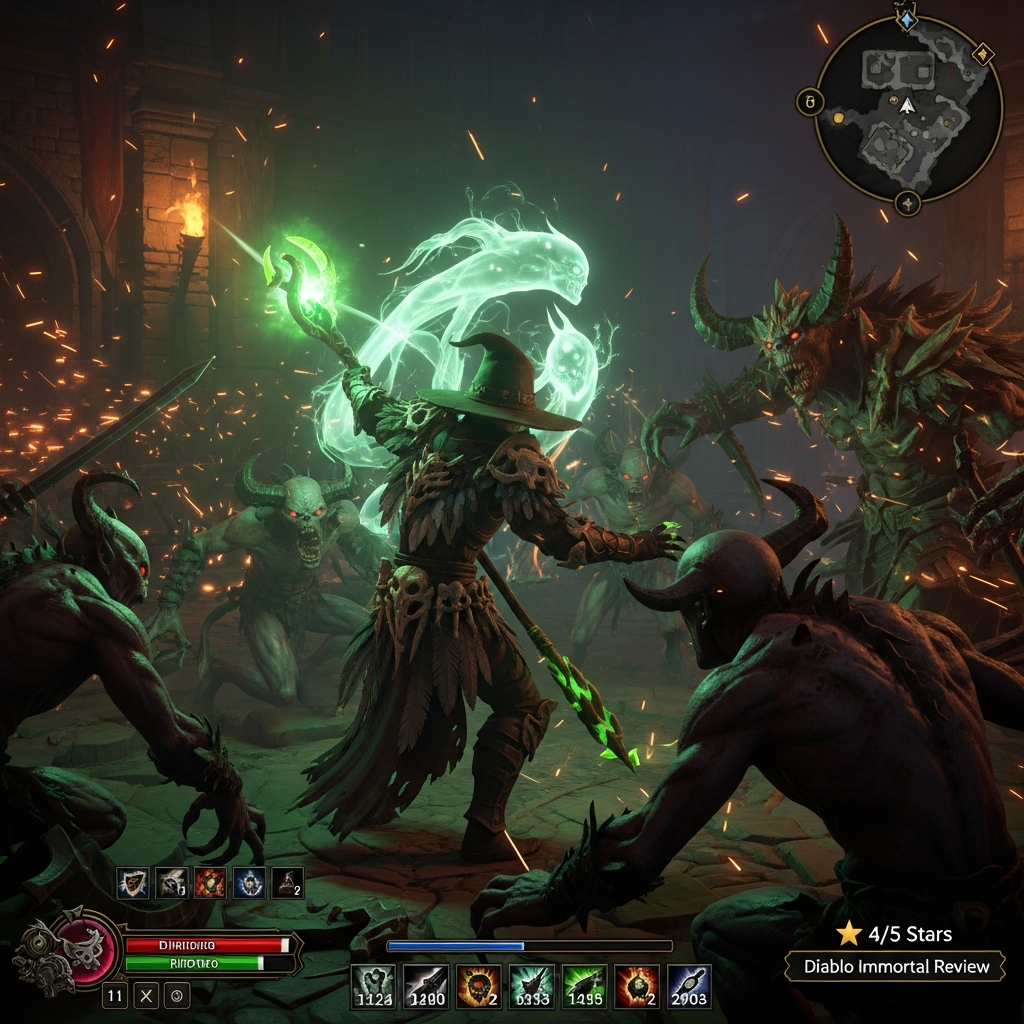
The gameplay in Diablo Immortal is remarkably fluid, especially for a mobile title. Blizzard and NetEase have optimized the touch controls to feel responsive and intuitive.
- The Control Scheme: On mobile, you use a virtual joystick on the left for movement and buttons on the right for your primary attack and four skill slots. On PC, you have the option of classic “point-and-click” or WASD movement.
- Combat Flow: The game rewards aggressive play. Defeating enemies drops “Health Globes” and “Energy Globes,” allowing you to stay in the fight without constantly relying on potions, which are on a limited cooldown.
- Skill Customization: While you have a limited number of skill slots, you can swap skills freely outside of combat. Furthermore, Legendary Items can modify how your skills work (e.g., turning a fire beam into an ice beam), allowing for diverse build experimentation.
The Progression System: Leveling and the Paragon System
Progression is the heart of any Diablo game. In Diablo Immortal, you will experience two distinct phases of growth.
The Road to Level 60
The initial leveling process serves as a massive tutorial and narrative campaign. You will travel through iconic zones like the Ashwold Cemetery and the Library of Zoltun Kulle. During this phase, you are constantly finding better gear, which keeps the “loot loop” satisfying.
The Paragon System
Once you hit the level cap of 60, the game truly begins. You enter the Paragon System, which allows you to continue earning experience points to unlock specialized talent trees. These trees offer bonuses to damage, survivability, or treasure finding. The Paragon level also dictates which “Hell Difficulty” you can enter, ensuring that the challenge scales with your power.
Gear, Loot, and Legendary Items
In our review of Diablo Immortal, the loot system stands out as both its greatest strength and its most complex feature.
- Rarity Tiers: Gear ranges from Common (White) to Legendary (Orange).
- Legendary Gems: These are the most powerful items in the game. They are slotted into your primary gear and provide massive stat boosts and unique effects. However, obtaining high-ranking Legendary Gems is the primary focus of the game’s monetization.
- The Armory: You can save different “loadouts” (combinations of skills and gear) in the Armory, making it easy to switch between a PvP build and a PvE farming build.
Social and Multiplayer Features
Diablo Immortal is designed to be played with others. It introduces several social structures that differentiate it from its predecessors:
- Clans: Joining a clan allows you to participate in large-scale social events and find reliable teammates for dungeons.
- Warbands: A smaller, more intimate group of 8 players who share a “Warband Camp” and work together to unlock collective bonuses.
- The Cycle of Strife: This is the game’s unique server-wide PvPvE system. Players are divided into two factions: The Shadows and The Immortals. The Shadows work to overthrow the current Immortals, culminating in a massive 30vs1 battle known as the Rite of Exile.
Monetization: Addressing the Elephant in the Room
No Diablo Immortal review is complete without discussing its business model. The game is Free-to-Play (F2P), but it heavily utilizes microtransactions.
- The Good: All story content, classes, and zones are 100% free. You can reach the endgame and enjoy hundreds of hours of gameplay without spending a dime.
- The Bad: The “endgame” power ceiling, particularly for competitive PvP, is heavily influenced by Legendary Gems. Acquiring the best 5-star gems requires “Legendary Crests,” which are primarily obtained through the in-game store.
- The Verdict for F2P Players: If you are a casual player who enjoys the story and cooperative dungeons, the monetization will likely not hinder your enjoyment. However, if you aim to be at the top of the PvP leaderboards, be prepared for a significant grind or financial investment.
Graphics and Performance
Visually, Diablo Immortal is a masterpiece of mobile engineering. The lighting effects, character animations, and environmental details are on par with many console games.
- Optimization: The game runs smoothly on most modern smartphones, though it can be taxing on battery life.
- PC Version: The PC port, while functional, still retains many mobile UI elements. However, it offers higher resolutions and better frame rates for those who prefer a larger screen.
Expert Tips for Beginners
To maximize your efficiency in Sanctuary, keep these tips in mind:
- Follow the Guidebook: The in-game “Codex” provides a clear path of what activities you should do daily to earn the most experience and rewards.
- Don’t Hoard Materials: Use your crafting materials to upgrade your gear slots immediately. These upgrades transfer even when you find a new piece of equipment.
- Join a Dark Clan: Even if you aren’t interested in heavy PvP, joining the Shadows provides significant buffs to your experience gain and damage.
- Participate in World Events: Events like the “Haunted Carriage” or “Ancient Nightmare” are great ways to earn guaranteed legendary loot.
Final Review Verdict: Is Diablo Immortal Worth Playing?
Pros:
- Exceptional combat mechanics and “feel.”
- High-quality production values (graphics and voice acting).
- Deep character customization through Legendary items.
- Extensive endgame content and social features.
- Cross-play and cross-save functionality.
Cons:
- Aggressive monetization in the late-game PvP.
- Can feel repetitive (the “daily grind” aspect).
- Heavy storage requirements (over 15GB on mobile).
Conclusion:
Diablo Immortal is a high-quality ARPG that successfully translates the core Diablo experience to a mobile format. While its monetization strategy is a valid point of criticism for competitive players, the sheer amount of free content and the polish of its gameplay make it a must-try for any fan of the genre. Whether you are playing for 15 minutes during a commute or for 3 hours on your PC, Sanctuary offers a dark and rewarding adventure.
Frequently Asked Questions (FAQ)
1. Is Diablo Immortal truly free to play?
Yes, you can play through the entire story campaign and access all zones and classes for free. Monetization mostly affects competitive PvP and the speed of endgame progression.
2. Can I play Diablo Immortal on my PC?
Yes, Blizzard offers a PC version with cross-play support, meaning you can switch between your phone and your computer using the same account.
3. Which class is best for solo players?
The Necromancer is widely considered the best solo class due to its ability to summon minions that tank damage, allowing you to stay safe.
4. How much storage space do I need?
You should clear at least 15-20GB of space on your mobile device to accommodate the full game assets and future updates.
5. Is there a way to change classes?
Yes, Diablo Immortal features a “Class Change” mechanic that allows you to switch your character’s class while retaining most of your progress and level.