Shadow Fight 4: Arena Gameplay Review – The Definitive Guide to Mastery
The mobile gaming landscape has undergone a massive transformation, shifting from simple arcade experiences to complex, high-fidelity competitive titles. At the forefront of this evolution is Shadow Fight 4: Arena, the latest installment in the legendary fighting franchise by Nekki. While its predecessors focused heavily on RPG-style progression and solo campaigns, Shadow Fight 4 pivots toward high-stakes, real-time PvP combat.
In this comprehensive review and gameplay guide, you will discover whether this title lives up to the legacy of the “Shadow Fight” name. We will dissect the mechanics, the roster of heroes, the visual fidelity, and the strategic depth required to climb the global leaderboards. Whether you are a veteran of the Shadow World or a newcomer looking for a competitive edge, this guide provides the insights you need.
The Evolution: From Shadow Fight 3 to the Arena
To understand Shadow Fight 4, you must first appreciate its lineage. Shadow Fight 2 introduced us to the silhouette-based aesthetic and physics-driven combat that felt heavy and deliberate. Shadow Fight 3 brought the characters into full 3D light, introducing a complex gear system. However, Shadow Fight 4: Arena is a different beast entirely.
This game strips away the “grind for gear” mechanic found in the third installment and replaces it with a Hero-based system. Each character is now a distinct entity with unique lore, weapons, and a specialized “Talent Tree.” This shift moves the game closer to the “Hero Fighter” sub-genre, similar to how Overwatch or Valorant functions in the FPS world, but within the 2D fighting plane.
Core Gameplay Mechanics: The Dance of Steel and Shadow
The combat in Shadow Fight 4 is built on a foundation of physics-based realism. Unlike “button mashers” where speed is the only factor, this game rewards patience, spacing, and timing. If you swing a heavy claymore and miss, you are left wide open for a counter-attack. This “weight” makes every move feel consequential.
1. The Control Scheme
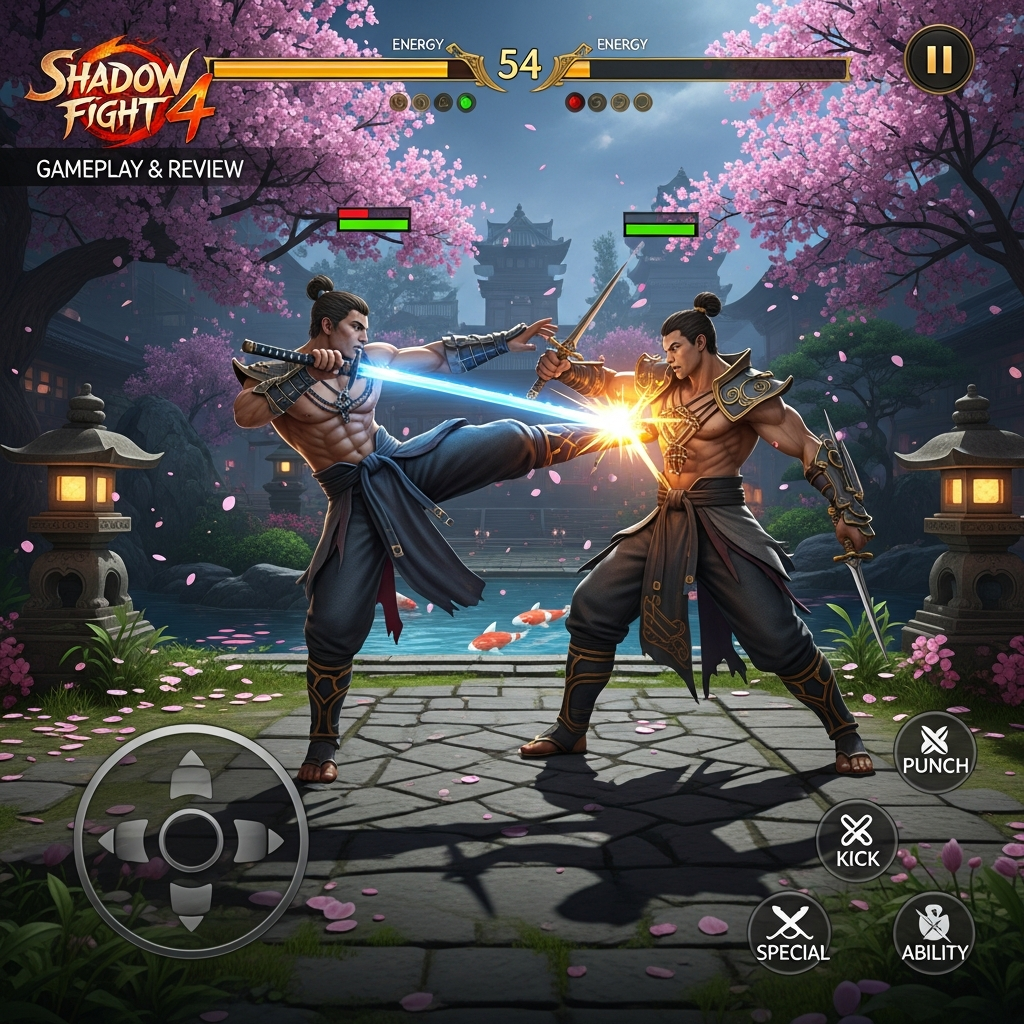
You are provided with a virtual joystick for movement and three primary action buttons: Punch, Kick, and Ranged Weapon. By combining the joystick direction with the punch or kick button, you execute different moves. For example, holding “Up” while punching might result in an overhead strike, while “Back” and punch might trigger a defensive hilt strike.
2. Shadow Energy and Shadow Form
The iconic Shadow Energy remains the centerpiece of gameplay. As you deal and receive damage, your shadow bar fills. Once full, you can enter “Shadow Form,” turning your character into a dark silhouette with access to devastating supernatural abilities. Mastering the transition into Shadow Form is often the difference between victory and defeat in the Arena.
3. The Block and Parry System
Shadow Fight 4 uses an automatic blocking system—if you stand still or move backward, your character will automatically block incoming frontal attacks. However, throws cannot be blocked. This creates a psychological “Rock-Paper-Scissors” dynamic: blocking beats attacks, throwing beats blocking, and attacking beats throwing attempts.
The Hero Roster: Choosing Your Champion
One of the most impressive aspects of the Shadow Fight 4 gameplay is the diversity of its roster. Each hero belongs to one of three factions: the disciplined Legion, the agile Dynasty, or the mysterious Heralds. Each faction has a distinct fighting philosophy.
- The Legion: These heroes rely on heavy armor and “Unbreakable” frames. During certain attacks, they cannot be interrupted, allowing them to trade damage effectively. Examples include Marcus and Ironclad.
- The Dynasty: High-mobility fighters who focus on long combos and rapid-fire strikes. They excel at keeping the pressure on the opponent. Jet and Hong-Joo are prime examples.
- The Heralds: Precision-based fighters who utilize critical hits and high-tech shadow abilities. They require high skill but offer massive burst damage. Look at Itu or Kibo.
The Talent Tree System
As you level up your heroes, you unlock Talents. These are not just stat boosts; they fundamentally change how a hero plays. For instance, you might choose a talent that makes your shadow abilities faster, or one that grants you health regeneration whenever you land a critical hit. This allows you to customize your hero to fit your personal playstyle.
Visuals and Technical Performance
Visually, Shadow Fight 4 is arguably the best-looking fighting game on mobile. The character models are highly detailed, featuring realistic fabric physics and metallic reflections. The animations are motion-captured, providing a level of fluidity that is rare in the mobile space.
The game supports high refresh rates, and playing at 60FPS is highly recommended for competitive play. The sound design is equally impressive, with the “clink” of katanas and the “thud” of heavy maces providing satisfying tactile feedback. The soundtrack blends traditional Eastern instruments with modern electronic beats, perfectly capturing the “Neo-Samurai” vibe of the series.
The Progression System: Shards and Currencies
While the gameplay is top-tier, the progression system is where most players will spend their time. Shadow Fight 4 uses a Shard System to unlock and upgrade heroes. You collect shards from chests, which you earn by winning matches or completing “Fight Pass” missions.
Is it Pay-to-Win? This is a common question for any competitive mobile game. While spending money can accelerate your hero’s level and talent unlocks, the matchmaking system generally tries to pair you with opponents of similar strength. Furthermore, a highly skilled player with lower-level heroes can still defeat a less skilled player with “maxed” characters due to the game’s high skill ceiling.
Competitive Modes: Story vs. Arena
Although the focus is on PvP, Nekki has introduced a Story Mode (Chronicles) that provides a rogue-lite experience. In this mode, you fight through waves of AI enemies, choosing temporary buffs after each round. It is an excellent way to practice with new heroes and earn rewards without the stress of ranked matches.
The Ranked Arena is the heart of the game. It uses a 3v3 or 1v1 format. In the 3v3 mode, you select a team of three heroes. When one hero is defeated, the next one steps in. This adds a layer of strategy regarding “counter-picking”—choosing a hero specifically to beat the opponent’s current fighter.
Expert Tips for Dominating the Arena
To succeed in Shadow Fight 4, you must move beyond basic button mashing. Here are professional strategies to elevate your game:
- Master the “Whiff Punish”: Wait for your opponent to swing and miss. The moment their animation is in the “recovery” phase, launch your fastest attack.
- Don’t Forget to Kick: Kicks are often faster than weapon attacks and are great for interrupting an opponent who is getting too close.
- Manage Your Distance: If you are playing a Herald with a long katana, keep your distance. If you are playing a Legionnaire with a short hammer, you must stay in the opponent’s face.
- Use Ranged Weapons Sparingly: Ranged weapons are easily dodged or blocked if used predictably. Use them to interrupt an opponent’s shadow ability or to finish off a sliver of health.
- Learn Frame Data (Intuitively): You don’t need to read spreadsheets, but you should know which of your moves are “safe” (meaning you can block immediately after) and which are “unsafe” (leaving you vulnerable).
Pros and Cons: An Honest Assessment
The Pros
- Incredible Graphics: Console-quality visuals on a mobile device.
- Deep Strategy: The talent system and hero variety offer endless tactical combinations.
- Fair Combat: Physics-based mechanics ensure that skill is the primary factor in winning.
- Frequent Updates: Nekki regularly adds new heroes, skins, and balance patches.
The Cons
- Aggressive Monetization: The shard system can feel slow for free-to-play players.
- Learning Curve: Beginners may find the “weighty” combat difficult to master initially.
- Network Sensitivity: Being a real-time PvP game, any lag can be frustrating.
Final Verdict: Is Shadow Fight 4 Worth Playing?
Shadow Fight 4: Arena is a triumph in mobile game design. It successfully transitions a beloved single-player franchise into a competitive multiplayer powerhouse without losing its soul. The combat is visceral, the heroes are charismatic, and the strategic depth is immense.
If you are looking for a game that rewards skill, patience, and tactical thinking rather than just fast reflexes, Shadow Fight 4 is a must-download. While the monetization system requires patience from free-to-play users, the core gameplay loop is so satisfying that the journey to the top of the Arena feels rewarding.
In the world of mobile fighting games, Shadow Fight 4 stands tall as the reigning champion. Prepare your weapons, harness your shadow energy, and step into the arena. Your journey to becoming a legend starts now.
Frequently Asked Questions (FAQ)
Is Shadow Fight 4 Arena offline?
No, Shadow Fight 4 is primarily an online multiplayer game. You need a stable internet connection to participate in PvP battles and to access the Story Mode, as rewards and progress are synced with the servers.
Which hero is the best in Shadow Fight 4?
There is no single “best” hero due to the game’s balance. However, heroes like Itu and Midnight are often considered high-tier due to their versatility. The best hero for you depends on your preferred playstyle (Aggressive, Defensive, or Tactical).
How do I unlock new heroes quickly?
The fastest way to unlock heroes is by completing the Fight Pass missions and participating in limited-time Events. Events often provide specific hero shards as rewards, allowing you to target the champions you want to add to your roster.
Can I play Shadow Fight 4 on PC?
Yes, Shadow Fight 4: Arena is available on Steam for PC. It features cross-platform play, allowing you to use your mobile account on your computer with enhanced graphics and keyboard/controller support.
What are Talents in Shadow Fight 4?
Talents are special abilities unlocked as you level up your hero. Each hero has a talent tree with multiple tiers. At each tier, you usually choose between two different talents, allowing you to specialize your hero for different combat scenarios.